Configuring Multi‑Rail Switching Hardware
By Rohit K Bhatnagar — A deep technical exploration into high‑throughput payment routing matrices, edge‑ledger configurations, and multi‑rail orchestration hardware as envisioned by MograPay.
Introduction
Modern payment infrastructure is no longer defined by a single rail or a single protocol. High‑throughput systems now operate across multiple rails simultaneously — ISO 8583 card networks, ISO 20022 banking rails, RTP/FedNow, tokenized agentic commerce flows, and proprietary merchant‑side routing layers.
Configuring multi‑rail switching hardware is the foundation of this evolution. It determines how fast transactions move, how intelligently they route, how resilient the system behaves under load, and how effectively fraud intelligence can be applied at the edge.
This guide explains how to design, configure, and optimize multi‑rail switching hardware for maximum throughput, minimum latency, and deterministic routing behavior across heterogeneous payment rails.
MograPay - Multi-Rail Switching Overview
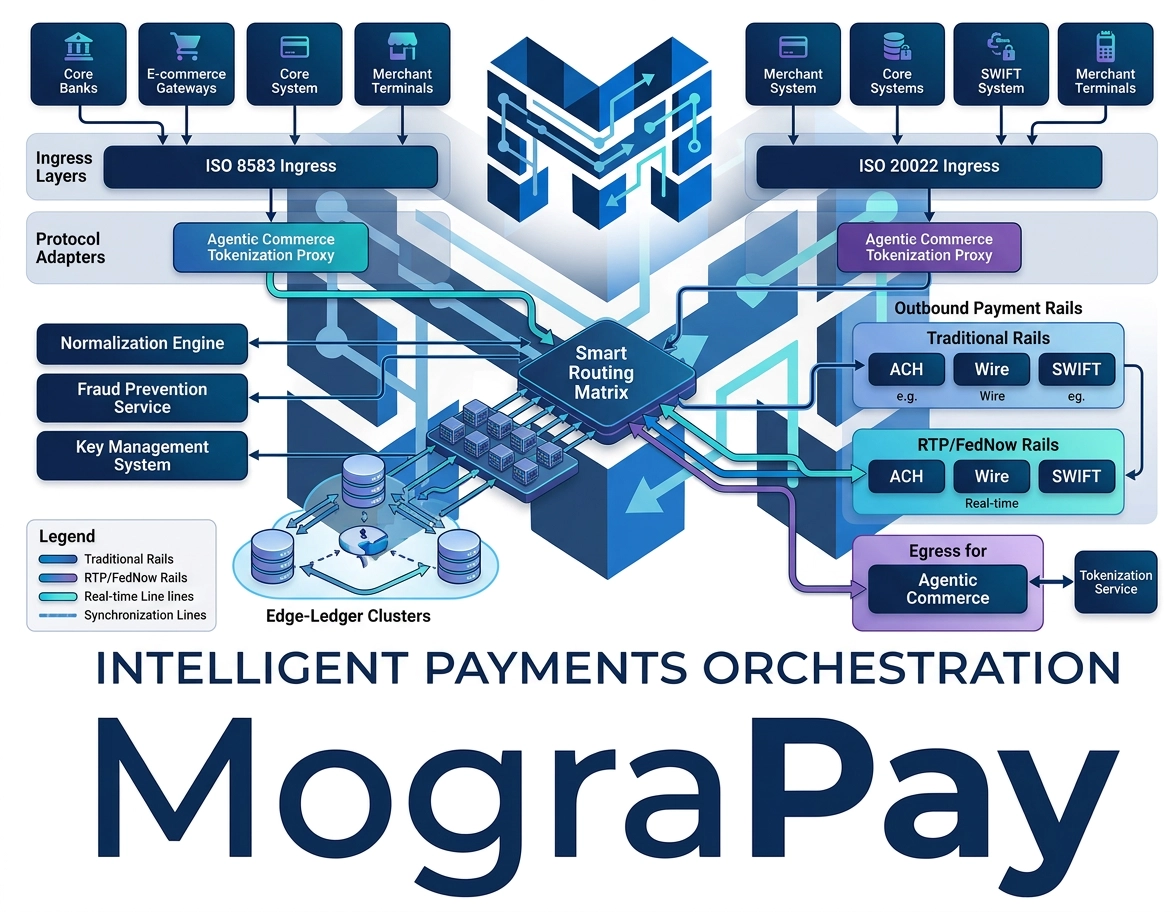
What This Diagram Represents
The multi‑rail switching overview diagram illustrates the complete end‑to‑end flow of a modern high‑throughput payment orchestration system. It visually maps how heterogeneous payment rails — including ISO 8583 card networks, ISO 20022 banking rails, RTP/FedNow real‑time rails, and tokenized agentic commerce flows — converge into a unified switching fabric capable of deterministic routing, fraud scoring, and edge‑ledger commit operations.
At the top side of the diagram, you will see multiple ingress channels, each representing a distinct payment rail. These channels feed into protocol adapters that decode, validate, and normalize incoming messages. For example:
- ISO 8583 Ingress — Traditional card authorization messages containing MTI, bitmap, and data elements.
- ISO 20022 Ingress — XML/JSON‑based banking messages with rich semantic metadata.
- RTP/FedNow Rails — Real‑time clearing and settlement messages requiring sub‑second processing.
- Tokenized Agentic Commerce Flows — Mandate‑based, cryptographically signed purchase instructions from AI agents.
These protocol adapters feed into a Normalization Engine, shown centrally (left side) in the diagram. This engine converts all incoming messages into a unified internal schema, enabling the switching hardware to treat every transaction consistently regardless of its originating rail.
The heart of the diagram is the Routing Matrix, depicted as a multi‑layer decision engine. This matrix evaluates dozens of factors — latency, cost, fraud score, merchant rules, rail availability, and fallback paths — to determine the optimal route for each transaction. The routing matrix is designed for high‑speed evaluation, typically under 10ms, ensuring that rail selection does not introduce latency overhead.
To the right of the routing matrix, the diagram shows hardware switching nodes and edge‑ledger clusters (bottom-left). These components provide deterministic ordering, replay protection, and high‑speed commit semantics. The edge ledger is partitioned by merchant, region, or rail, enabling 25,000 TPS sustained throughput and 50,000+ TPS burst capacity.
In summary, this diagram provides a high‑level visual blueprint of how multi‑rail payment systems operate at scale, how they unify disparate protocols, and how orchestration logic drives intelligent routing across global payment networks which MograPay envisions.
Understanding Multi‑Rail Switching Architecture
Multi‑rail switching hardware is designed to ingest, normalize, and route transactions across multiple payment rails simultaneously. Each rail has unique message formats, latency expectations, compliance constraints, and settlement semantics.
Core Components
- Ingress Adapters — Protocol‑specific adapters for ISO 8583, ISO 20022, RTP, tokenized agentic flows.
- Normalization Engine — Converts heterogeneous messages into a unified internal schema.
- Routing Matrix — Determines optimal rail selection based on cost, latency, risk, and merchant rules.
- Edge Ledger — High‑speed, append‑only ledger for deterministic transaction ordering.
- Fraud Intelligence Layer — ML‑driven scoring applied at ingress and routing time.
- Rail‑Specific Connectors — Outbound connectors for card networks, banks, RTP, and token providers.
The orchestration challenge lies in ensuring that each rail behaves predictably under load while maintaining sub‑200ms end‑to‑end latency for card authorizations and sub‑500ms latency for ISO 20022 banking flows.
MograPay - Routing Matrix Internals
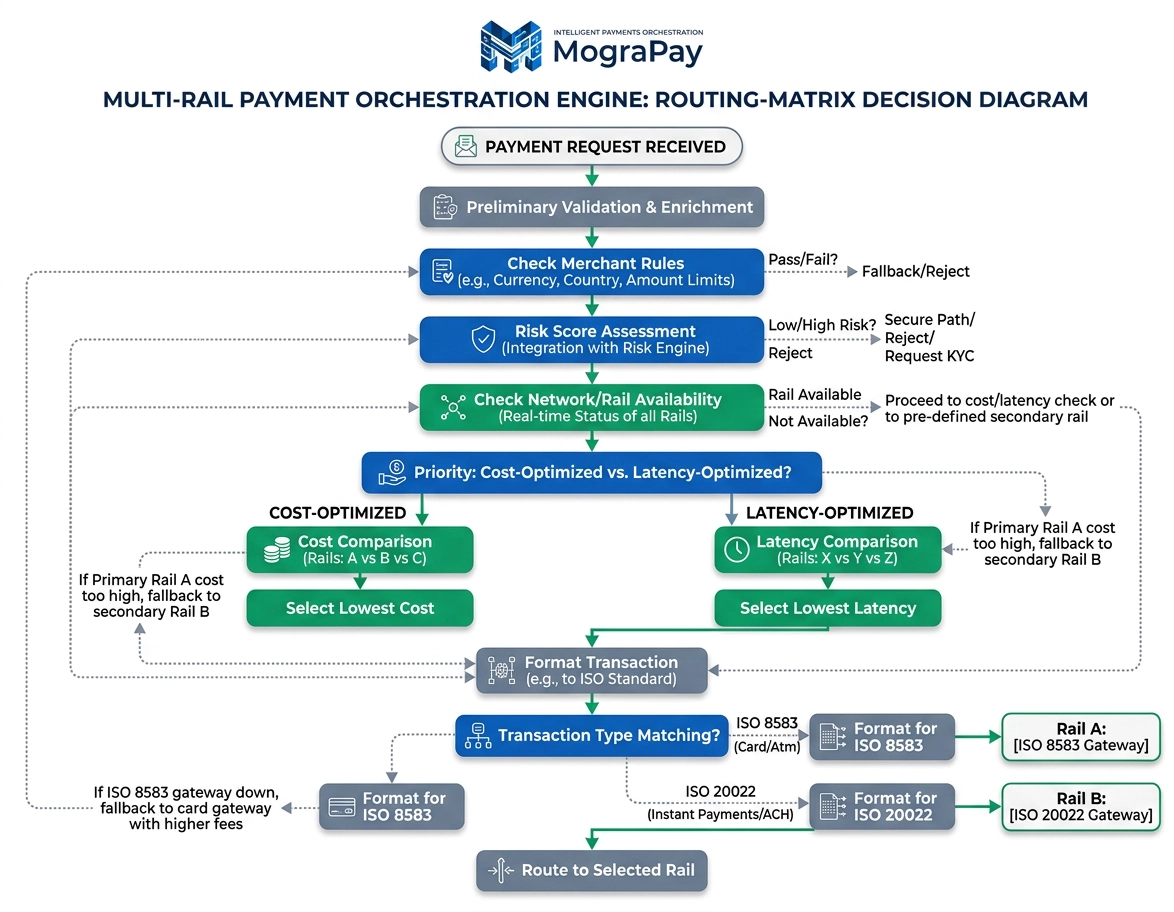
Understanding the Routing Matrix Internals
Routing diagram above provides a deep look inside the Routing Matrix, the core intelligence layer responsible for determining how each transaction flows across multiple payment rails. The routing matrix is not a simple decision tree — it is a multi‑dimensional evaluation engine that processes dozens of variables in real time to ensure optimal routing behavior.
At the top of the diagram, you will see ingress decision nodes representing the initial classification of the transaction. These nodes evaluate the originating rail (ISO 8583, ISO 20022, RTP, tokenized agentic flows) and extract key metadata such as merchant category, transaction amount, currency, and risk indicators.
The center of the diagram illustrates the decision layers that form the routing matrix. Each layer represents a different dimension of routing logic:
- Latency Layer — Evaluates rail‑specific round‑trip times and congestion.
- Cost Layer — Considers interchange fees, settlement costs, and network pricing.
- Risk Layer — Integrates fraud scores, behavioral analytics, and agentic risk signals.
- Availability Layer — Detects rail outages, degraded performance, or maintenance windows.
- Merchant Rules Layer — Applies merchant‑specific routing preferences and constraints.
- Fallback Layer — Defines deterministic fallback paths for resilience.
The bottom of the diagram shows the rail selection output, where the matrix chooses the optimal rail for the transaction. This selection is performed in under 10ms, ensuring that routing logic does not introduce latency overhead.
Overall, this diagram visualizes how the routing matrix transforms raw transaction data into intelligent routing decisions, enabling high‑throughput, low‑latency multi‑rail orchestration.
Configuring Edge Ledger Clusters
The edge ledger is the backbone of multi‑rail switching hardware. It provides deterministic ordering, replay protection, and high‑speed commit semantics.
Key Configuration Principles
- Partitioning — Partition ledgers by merchant, rail, or region to reduce contention.
- Append‑Only Writes — Ensures high‑speed ingestion and replay consistency.
- Ledger Replication — Multi‑region replication for resilience and disaster recovery.
- Rail‑Aware Commit Rules — Different rails require different commit semantics.
Edge ledger clusters must be tuned for 25,000 TPS sustained throughput and 50,000+ TPS burst capacity. This requires careful configuration of memory‑mapped files, write‑ahead logs, and rail‑specific commit pipelines.
MograPay - Edge Ledger Cluster Layout
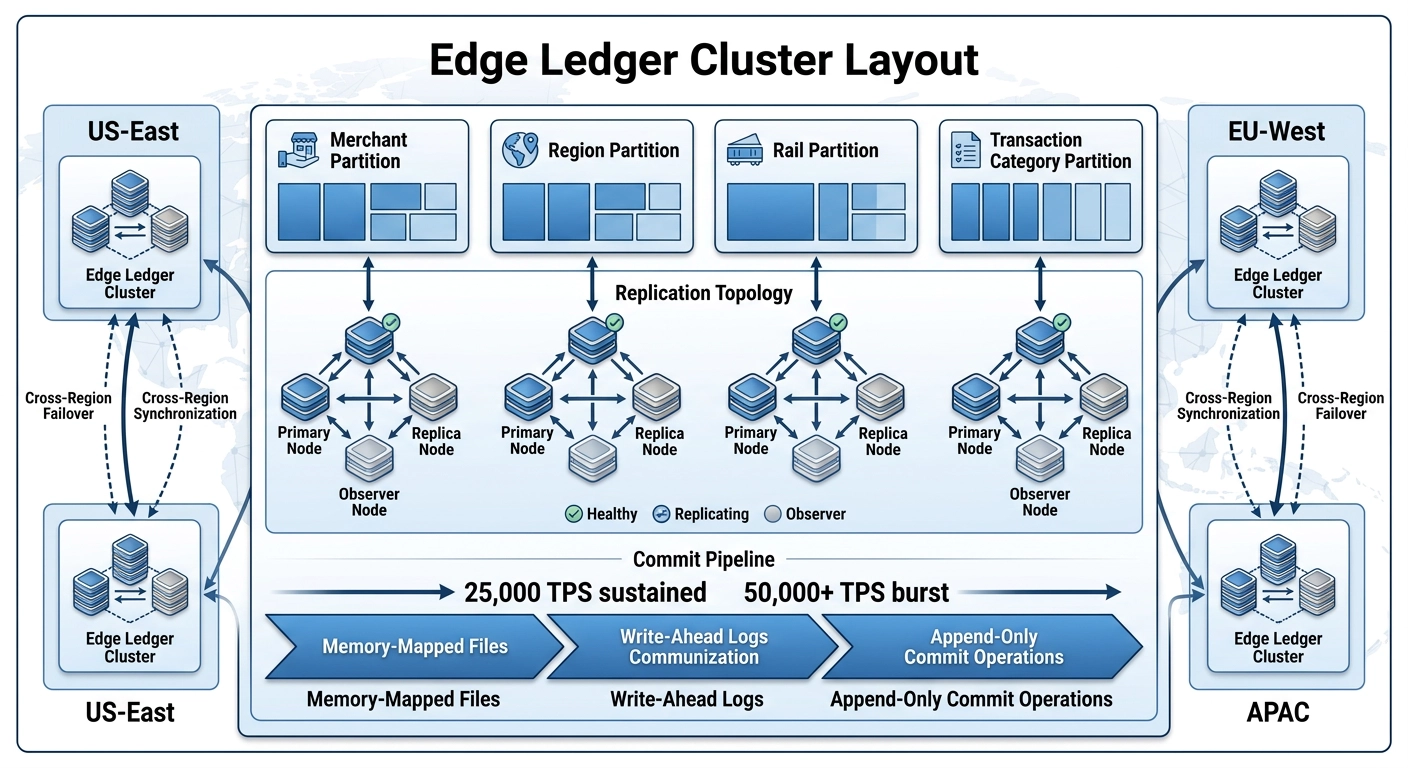
Understanding the Edge Ledger Cluster Layout
This diagram illustrates the architecture of the Edge Ledger Cluster, the high‑speed distributed ledger responsible for deterministic transaction ordering, replay protection, and multi‑region resilience.
At the top of the diagram, you will see ledger partitions representing how the system divides transaction workloads. Partitions may be organized by merchant, region, rail type, or transaction category. Partitioning reduces contention and enables parallel processing at scale.
The center of the diagram highlights the replication topology. Each ledger partition is replicated across multiple nodes to ensure durability and fault tolerance. The topology may include:
- Primary Nodes — Handle write operations and commit sequencing.
- Replica Nodes — Maintain synchronized copies for failover.
- Observer Nodes — Provide read‑only access for analytics and fraud intelligence.
The bottom of the diagram shows the commit pipeline, which includes memory‑mapped files, write‑ahead logs, and append‑only commit operations. These components ensure that the ledger can sustain 25,000 TPS with bursts exceeding 50,000 TPS.
The diagram also depicts multi‑region failover, illustrating how ledger nodes synchronize across geographic regions to maintain continuity during outages or network disruptions.
In summary, this diagram visualizes the distributed, fault‑tolerant architecture that enables high‑throughput, low‑latency ledger operations at the edge of the payment switching system.
Maximizing High‑Throughput Routing
High‑throughput routing requires a combination of hardware acceleration, protocol‑aware batching, and intelligent rail selection. The routing matrix must evaluate multiple factors in real time:
- Latency — Rail‑specific round‑trip times.
- Cost — Interchange, network fees, settlement fees.
- Risk — Fraud score, merchant category, agentic behavior.
- Availability — Rail uptime, congestion, fallback paths.
The routing matrix should be capable of evaluating hundreds of decision variables in under 10ms, ensuring that rail selection does not introduce latency overhead.
MograPay - High‑Throughput Routing Pipeline
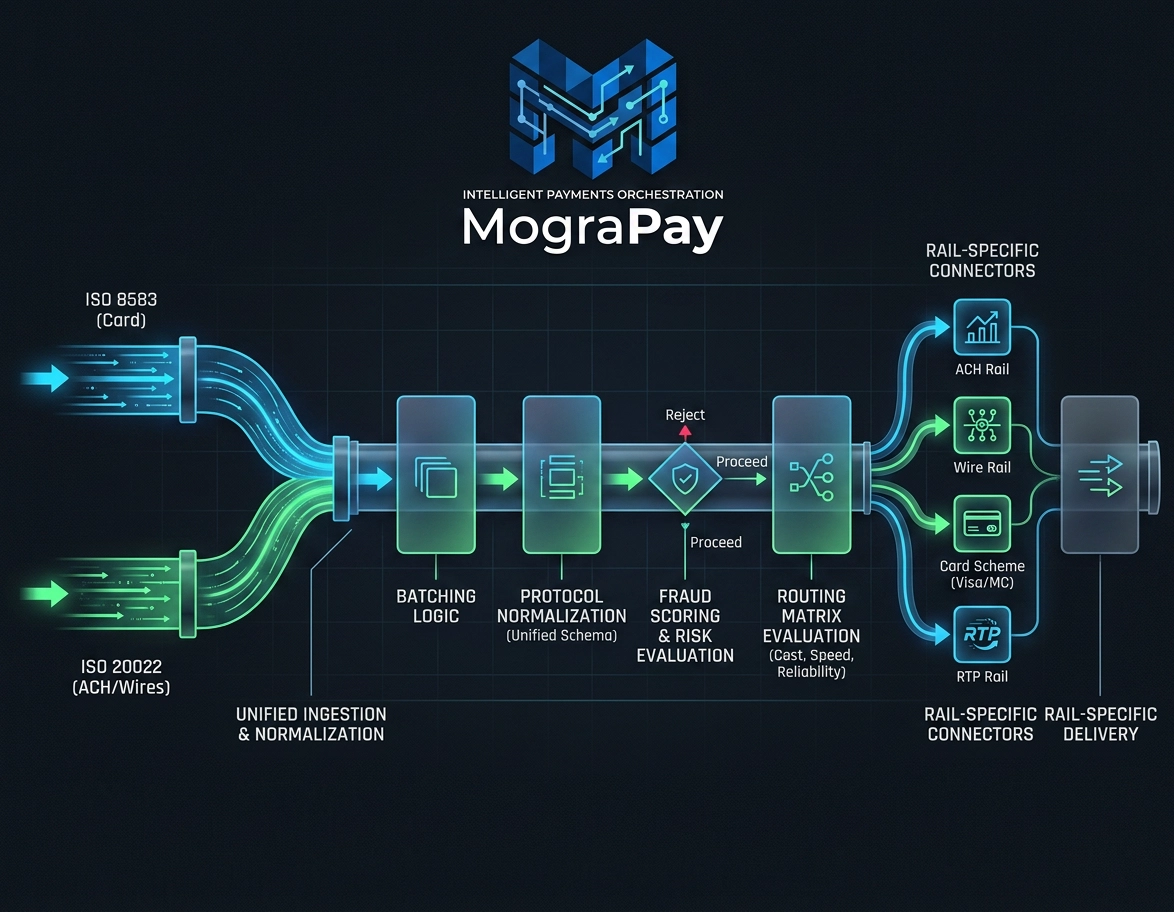
Understanding the High‑Throughput Routing Pipeline
This diagram provides a detailed view of the High‑Throughput Routing Pipeline, the sequential processing flow that transforms raw transaction messages into fully routed, fraud‑scored, rail‑optimized payment instructions.
At the left side of the diagram, you will see protocol ingress channels representing ISO 8583, ISO 20022, RTP, and tokenized agentic flows. These channels feed into the Normalization Stage, where messages are converted into a unified internal schema.
The center of the diagram illustrates the Batching and Pre‑Processing Stage. High‑throughput systems often batch transactions to reduce overhead and improve throughput. This stage includes:
- Protocol‑aware batching — Groups similar messages for efficient processing.
- Pre‑validation — Ensures message integrity before routing.
- Fraud pre‑scoring — Applies lightweight heuristics before full ML scoring.
The next stage is the Routing Matrix Evaluation, where the system determines the optimal rail based on latency, cost, risk, merchant rules, and availability.
The final stage shows Rail‑Specific Connectors, which translate the routed transaction into the appropriate protocol format for the selected rail.
This diagram demonstrates how the routing pipeline maintains high throughput while preserving deterministic routing behavior and low latency.
Integrating Fraud Intelligence into Multi‑Rail Switching
Fraud intelligence must operate at the ingress layer and the routing layer. Multi‑rail switching hardware provides the perfect environment for ML‑driven fraud scoring because it has access to:
- ISO 8583 field‑level signals (DE2, DE3, DE4, DE22, DE41, DE49)
- ISO 20022 semantic metadata (purpose codes, regulatory fields, debtor/creditor profiles)
- Rail‑specific behavioral patterns
- Agentic commerce mandates and token constraints
Fraud Scoring Pipeline
ISO 8583 / ISO 20022
        │
        ▼
Normalization → Feature Extraction → ML Models → Risk Engine → Route / Step‑Up / Decline
Fraud scoring must complete in <150ms to avoid impacting authorization latency. Multi‑rail switching hardware enables parallel scoring across rails, improving detection accuracy and reducing false positives.
MograPay - Fraud Intelligence Architecture
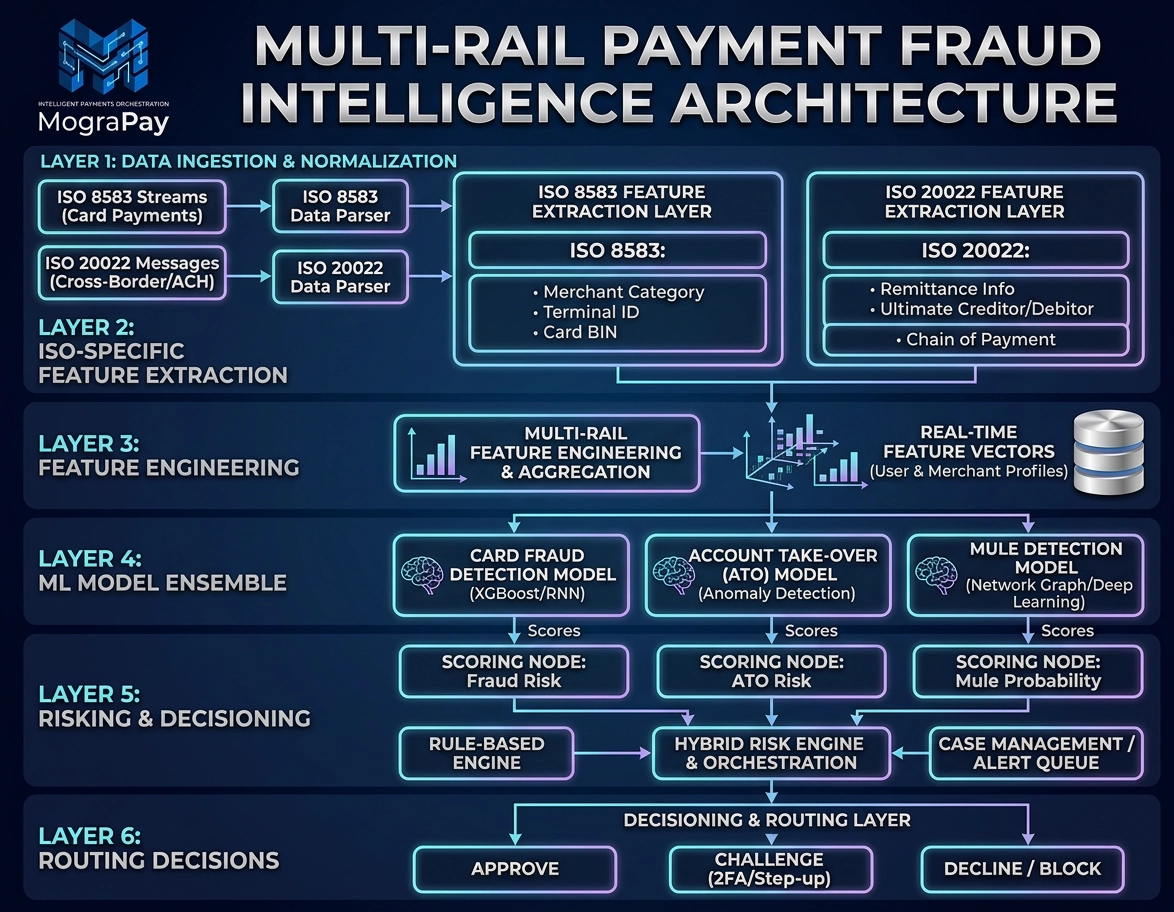
Understanding the Fraud Intelligence Architecture
This diagram visualizes the Fraud Intelligence Architecture, the machine‑learning pipeline responsible for detecting fraud across multiple payment rails in real time.
At the top of the diagram, you will see ISO 8583 and ISO 20022 feature extraction layers. These layers convert raw protocol fields into structured feature vectors. Examples include:
- ISO 8583 fields such as DE2, DE3, DE4, DE22, DE41, DE49.
- ISO 20022 metadata such as purpose codes, regulatory fields, debtor/creditor profiles.
- Agentic commerce mandate attributes.
The center of the diagram shows the ML Model Layer, which includes multiple models:
- Fraud Detection Model — Identifies anomalous behavior.
- Account Takeover Model — Detects compromised accounts.
- Mule Detection Model — Identifies suspicious movement patterns.
- Agentic Risk Model — Scores AI‑driven purchase behavior.
The bottom of the diagram illustrates the Risk Engine, which aggregates model outputs and determines whether to route, step‑up authenticate, or decline the transaction.
This architecture ensures that fraud scoring completes in <150ms, preserving authorization latency while providing robust protection across all rails.
Compliance & Engineering Scale
Multi‑rail switching hardware must comply with global standards:
- PCI DSS Level 1
- SOC 2 Type II
- ISO 27001
- EMVCo cryptogram validation
- NACHA, SWIFT CBPR+, FedNow ISO 20022 schemas
Engineering scale must support:
- 25,000 TPS sustained
- 50,000+ TPS burst
- P99 latency < 200ms
- Active‑active multi‑region clusters
- Zero‑downtime deployments
MograPay - Multi‑Rail Orchestration Blueprint
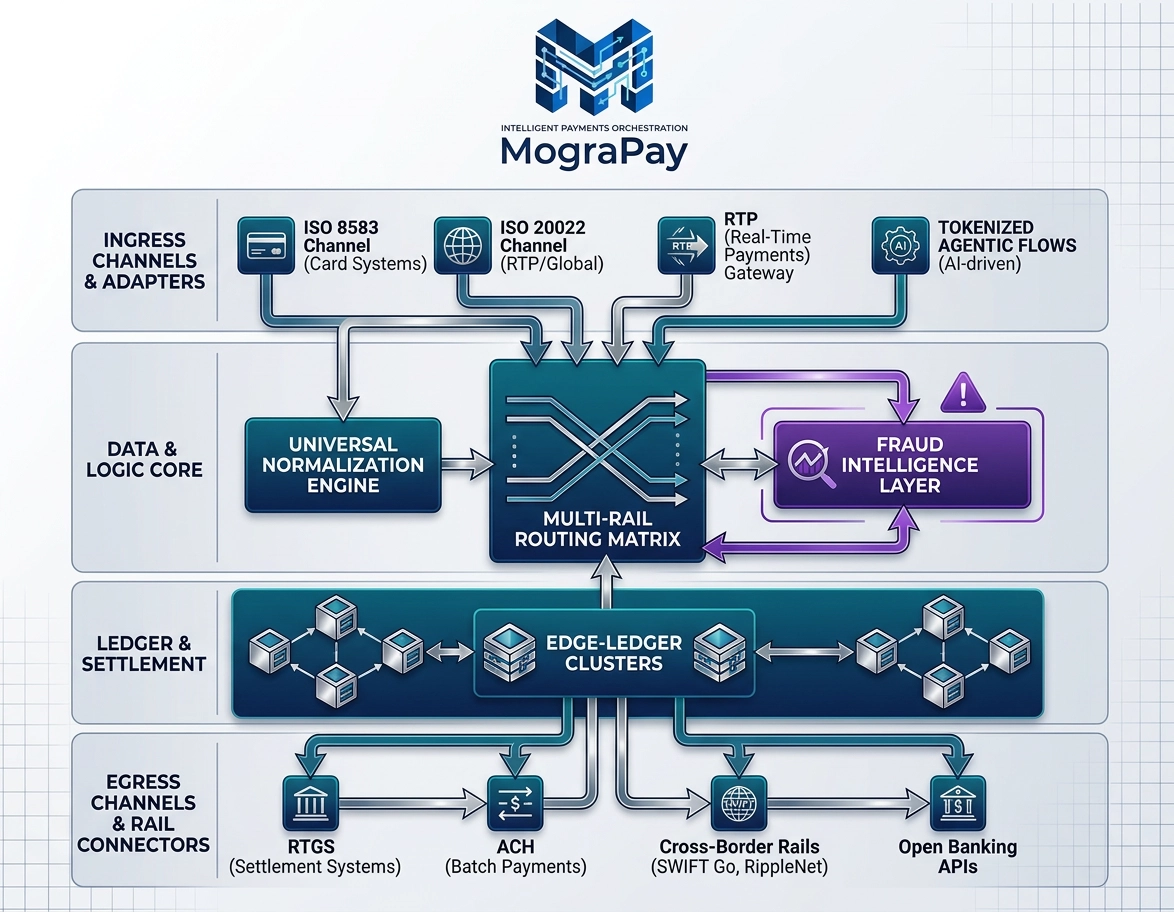
Understanding the Full Multi‑Rail Orchestration Blueprint
This diagram presents the complete orchestration blueprint, combining all components of the multi‑rail switching system into a single unified architectural view.
At the top, you will see Ingress Adapters for ISO 8583, ISO 20022, RTP, and tokenized agentic commerce flows. These adapters decode and validate incoming messages.
The center of the diagram highlights the Normalization Engine, Routing Matrix, and Fraud Intelligence Layer. These components work together to transform raw messages into intelligently routed, fraud‑scored payment instructions.
Just underneath, the diagram shows Edge Ledger Clusters and Rail‑Specific Connectors. These components ensure deterministic ordering, high‑speed commit operations, and protocol‑specific outbound formatting.
The bottom of the diagram illustrates multi‑region deployment, showing how the orchestration system spans multiple geographic zones for resilience, compliance, and low‑latency access.
This blueprint provides a holistic view of how modern payment systems unify disparate rails, apply intelligence, and maintain global reliability at scale.
Conclusion
Multi‑rail switching hardware is the foundation of modern payment orchestration. It enables high‑throughput routing, deterministic ledger behavior, intelligent rail selection, and ML‑driven fraud scoring — all while maintaining strict compliance and global interoperability.
As payment systems evolve toward agentic commerce, tokenized mandates, and real‑time settlement, multi‑rail switching hardware will become the most critical infrastructure layer in the fintech stack.