When multi-agent e-commerce networks move execution responsibility away from manual human oversight, transaction security parameters must transition completely from asynchronous post-auth scoring down to millisecond-level inline predictive interception.
The Architecture of Microsecond Inference Checking
Traditional fraud evaluation is plagued by architectural latency. Standard risk platforms accept financial payloads, execute write operations to persistent storage databases, and trigger separate webhooks to run analytics asynchronously. This delayed verification workflow is completely untenable inside high-velocity payment pipelines processing enterprise payloads.
MograPay overcomes this barrier by hardcoding our machine learning scoring parameters directly into the volatile execution flow of the Orchestration Gateway. By maintaining transaction state parameters completely in-memory, the platform strips messaging payloads down to clean behavioral tensors, maps features into specialized low-latency matrices, and generates a definitive security validation array entirely within the critical transaction processing path.
Processing Topology: In-Line Machine Learning Interception
Visualizing the synchronous multi-tier data pipeline extracting data features, engineering tensors, and evaluating risk thresholds inside the live engine thread.
MograPay - Machine Learning Pipeline
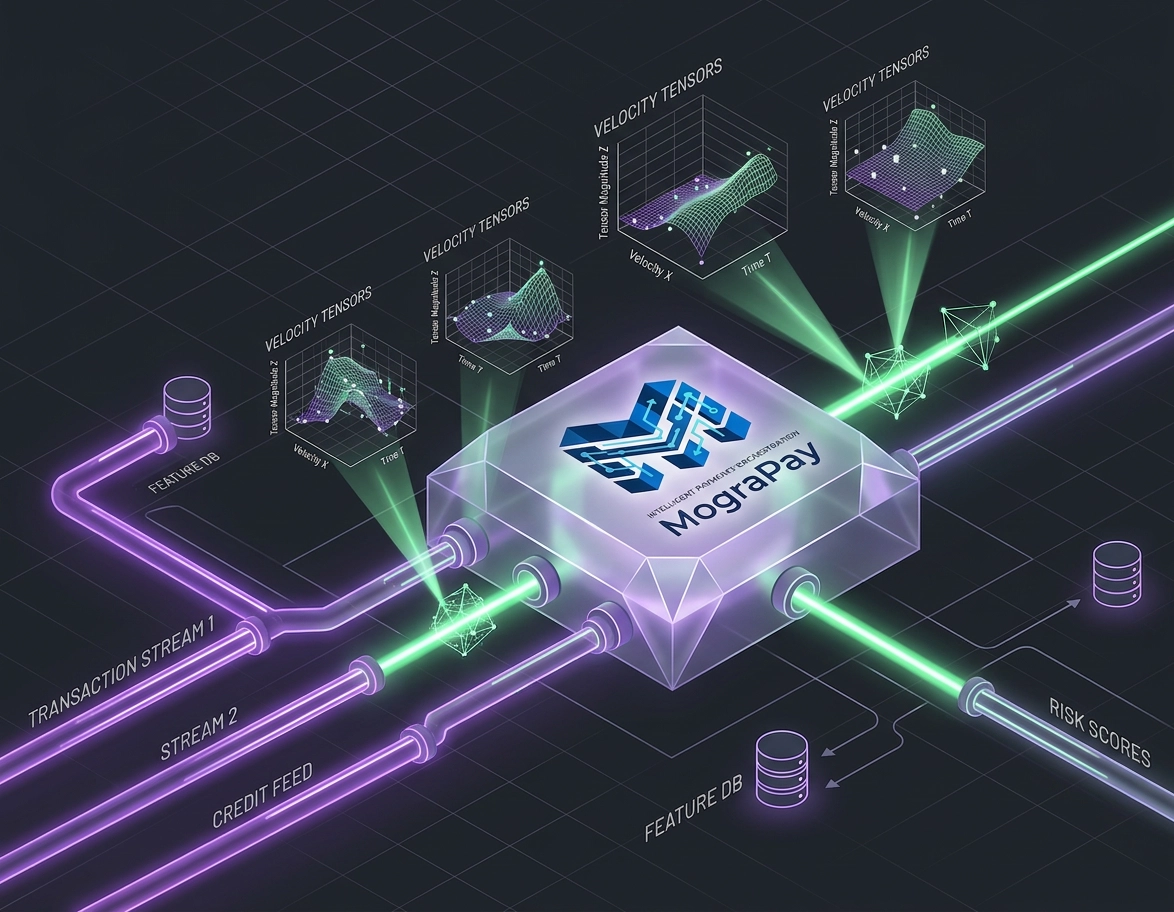
Mathematical Velocity Modeling Across Distributed Tensors
The core challenge of automated transaction tracking is isolating high-velocity script attacks from benign automated purchase sequences. Traditional velocity calculations rely on basic counter locks, tracking rules like "How many charges did Card X execute inside 60 seconds?" While performant, this primitive tracking parameter triggers high numbers of false-positives when encountering smart shopping agents managing cross-merchant setups simultaneously.
MograPay replaces basic scalar counters with multi-dimensional Velocity Tensors. Our engineering models don't just calculate card recurrence counts—they evaluate mathematical vectors tracking device fingerprint decay rates, geographical distance vectors over short time intervals, payload structural variance indicators, and protocol change patterns across distributed endpoints concurrently.
Advanced Behavioral Feature Vectors
By modeling transaction patterns as complex spatial coordinate vectors instead of isolated static parameters, the Intelligence Layer recognizes automated bot attacks instantly, even when changes are distributed across independent merchants, card tokens, and cross-border bank switches.
Achieving Scale: Sub-300ms Deadlines and FIPS 140-2 Integrity
Running advanced deep learning model structures in-line with global transaction flows introduces a significant engineering challenge: The Processing Overhead Crisis. To remain transparent to core banking switches, our engine must execute parsing mechanics, state lookups, tensor mapping, and mathematical risk evaluations without delaying processing strings.
MograPay answers this requirement with strict performance boundaries. The entire machine learning evaluation lifecycle is completed within a strict sub-300ms timeline boundary, handling peaks of 6,000+ Transactions Per Second (TPS) with extreme durability.
Security Matrix: FIPS 140-2 Cryptographic Isolation Framework
Illustrating out-of-band data mapping where sensitive cardholder variables are securely tokenized before entering analytical machine learning models.
MograPay - Cryptographic Isolation Framework
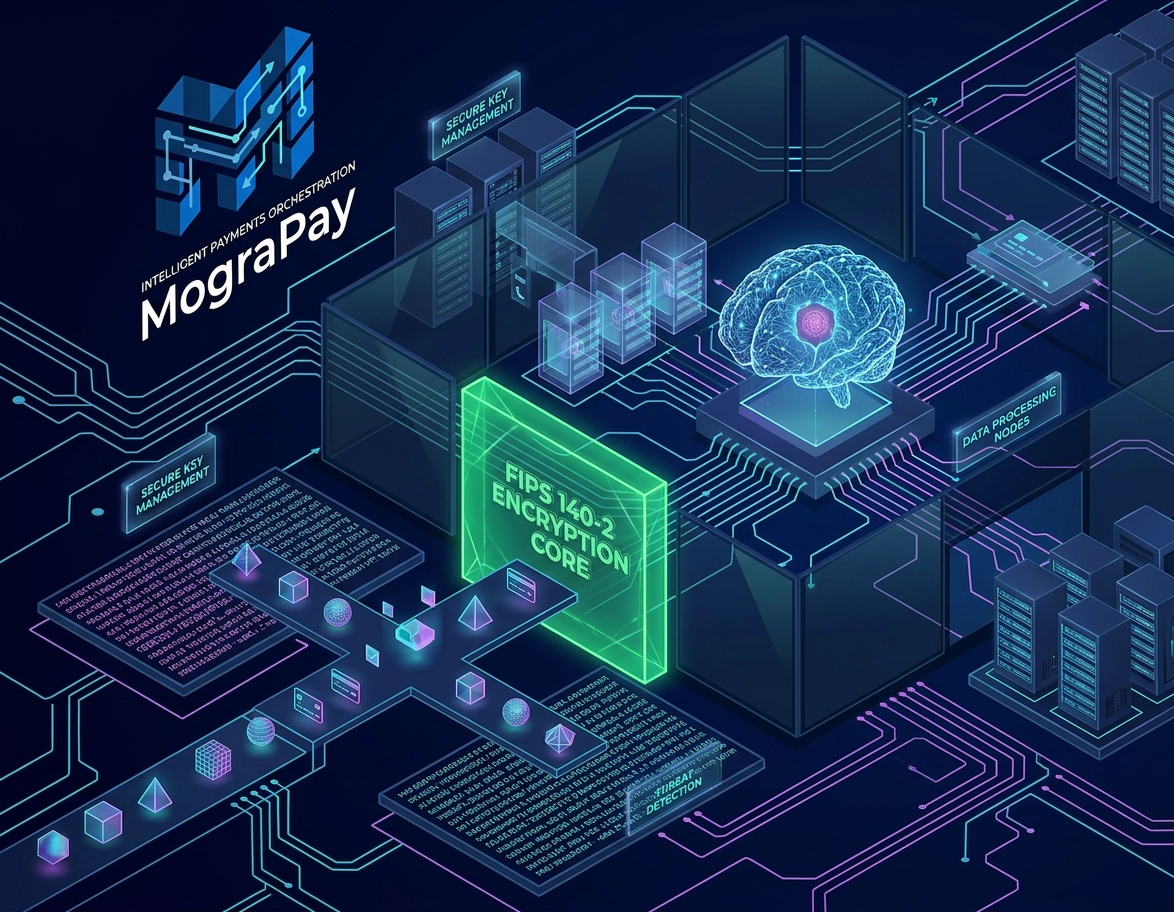
Furthermore, this high-throughput pipeline preserves total compliance. Our system isolates sensitive values from open analytical layers by keeping raw data strings strictly partitioned within secure environments aligned with FIPS 140-2 guidelines. By decoupling cardholder verification parameters from behavioral models, MograPay ensures complete system security and provides financial enterprises with a highly scalable infrastructure moat for modern automated commerce.